Interview: Sebastian Mullaert and Tamarma on their collaborative album 'Holds The Sky' and their journey to inspire
Giving a big welcome to Sebastian Mullaert and Tamarma to the ASW family. Ahead of their beautiful ‘Holds The Sky’ album landing at the end of this month, we wanted to spend some time digging a bit deeper into the concepts around the release, what music means to them and the inspirational ideas, and messages they aim to share via the art of music.
A touching body of work that scratches way beneath the surface, a synonymous feat with Sebastian’s work and as he collaborates with the Georgian musician Tamarma, this energy is enforced even deeper.
Let’s dive into the discussion…
Hi Sebastian, and Tamarma. Welcome to the world of Awesome Soundwave, it is a pleasure to have you on board with us, and we can not wait to release the ‘Holds The Sky’ album to the world in September. How has the summer been for you both so far?
S: Thank you so much. Such a pleasure to be welcomed into the Awesome Soundwave family. I feel a lot of warmth, a lot of real and genuine intention to invite creativity, and also a very clear intention from Awesome Soundwave to encourage people to improvise, to play live and to collaborate. And all of these are probably at the core of most things I do today. So thank you so much for trusting us, trusting our music, and I hope this collaboration continues to unfold in beautiful ways.
Summer here in Sweden, in the woods of Söderåsen, has been amazing. Summer is always a bit intense, I think, for many people. Also for us here, it’s a little bit of a multi juggling situation with our beautiful bed and breakfast, Villa Söderåsen, events, concerts, coaching, beautiful music releases and amazing artists coming here to collaborate with me. But this was my dream, and now I live it, and then you have to do it. :)
T: It’s a pleasure to be connected. Thank you for inviting me.
Summer began with a burst of colours. Releasing our new single “Being colors” felt like a great opening of a chapter and that energy has really set the tone for the rest of the season. Right now I’m staying in that creative flow,merging myself with different tones and letting the response to the single inspire the next wave of music. There is definitely more to come.
Before the music, let’s talk a bit about how you met and the early days of the collaboration. What do you remember from those early moments?
S: I’m very curious to hear Tamara’s answer on this one. Memories, like everything else, are changing and evolving, so we might have very different memories of how this happened. So this is me trying to remember.
When the pandemic hit, I started the mentorship program under the In Bloom umbrella. It was 2020, and it was, you could say, a sidestep away from my initial intention and plan to do physical retreats here in Röstånga. Obviously that was not possible, so the manager I worked with at the time, Niko, encouraged me to try to redesign the program as an online course. I was very hesitant, but I’m very thankful to him that he did that.
It turned into, I think, 15 different groups, each doing a 10 week program, and was in many ways an important foundation for me to really deepen, explore and practice my understanding of what I want to teach, how to communicate it, and how to welcome people into their creativity, their presence and their workflow.
In one of the first courses, I don’t know if it was the absolute first one or one of the first ones, Tamara applied for a scholarship. I always have scholarship slots for everything I do, both online and for physical workshops and retreats, and of course there are always many applications. But something with Tamara felt very real, and I felt very curious.
So Tamara joined that first course. Then I did a step two course, another 10 weeks, which she also joined through a scholarship. And then the third phase was a one year program with a smaller group, and she joined that one too.
Throughout all the courses I always felt something with Tamara, and I think this is probably also, in many ways, when I feel attraction or curiosity or a spark: when I feel something genuine. Not someone trying to produce or manufacture an idea or copy a concept, but someone who is, in her or his own way, exploring what it means to express energy for them at that specific point. And that I felt, and still continuously feel, with Tamara. I’m so thankful to get the chance to work with artists like this.
I think the clear moment when I knew I wanted to work with Tamara was during this third phase, the one year program. In those classes we always had listening sessions where people had the possibility to share their work and ask for feedback if they wanted. Tamara shared one song with piano, electronics and her voice, and it was just: this is so beautiful, this is so genuine, this is so raw and true.
After that I asked Tamara if she wanted to collaborate. And that song is actually the whole foundation for the entire album. A bit ironically, the original version is not on the album, but it’s something I’m also really looking forward to sharing with the world.
So that’s my memory.
T: I had gone through some major life changes and stepped back from everything well before pandemic, preparing for what I sensed would be a long creative winter. That period, turned out to be powerful space for reflection and growth. Wanting to navigate my musical journey independently,I began learning Ableton.
During that time,I stumbled upon on Ableton video of Sebastian performing live and sharing his production approach. I was literally glued to the screen- here was someone playing electronic instruments with sensibility ,atmosphere and depth. That directly spoke to me.
After researching further,I discovered that Circle Of Live was running the in Bloom mentorship program. I submitted my application and was fortunate enough to receive a scholarship. That’s really where this whole story begins.
When did you realise that a deeper collaboration was possible? Which has now blossomed into this beautiful body of work.
S: I would say it was that moment when I heard the track that was to become the foundation for the whole album. And then, as beautiful blossoms always do, they grow, they explore, and they naturally bloom into the essence they can be through the conditions they are given.
And our little flower to the world is this album. And again, we are so thankful for all the nutrition this little flower is receiving, allowing it to be explored and experienced by others.
T: To be honest I haven’t even let myself think about it. I couldn’t have imagined Sebastian would be interested in collaborating at that stage. When the idea first came up, I was beyond thrilled.
You both come from different backgrounds musically, and physically, what surprised you about the others' creative processes whilst making the album?
S: We indeed come from very different backgrounds, upbringings and cultures. And I think differences and diversity are always an important part of something new and different. But I would also like to point out that we probably have a lot of similarities.
Sometimes I feel there is an interesting attraction and curiosity when there is this combination of something different, but also something recognizable. At least for me, when I meet people, it can almost be too challenging to invite something that is too different. Not because I would not like to, just recognizing a little bit of what is happening. But it’s also not very exciting if something is too similar. So it’s that combination: freshness, differences, new perspectives, putting light on new emotions, but yet a certain familiarity.
And I think some of the similarities that Tamara and I share, and this is my speculation, are that we both come from classical music, acoustic music, traditional music and folk music. That was a big part of our youth and something we both really devoted ourselves to. And then, for both of us, something within electronic music was calling us. There was a certain curiosity, looking for something different, looking for ways to express and explore beyond the traditional ways of doing it.
My own journey went from classical music to pop, into the rave scene, dancing, and then into producing electronic music and really trying to discover and learn that on my own. Still, until today, I have no education in production or electronic music making. And that turning point came when I was still a teenager in the 90s.
Tamara had this shift a little bit later, but I can still see a certain shared narrative of exploring something more traditionally musical, then losing the spark for that and looking for something more challenging, more avant garde, less established and less prepared. And then the electronic music scene, and the approach of making music with electronic machines, opened the door for those wishes..
T: I honestly didn’t feel much of a gap at all. Despite the distance and different paths, I feel like we listen to the same space. I know that sounds abstract,but in practice,it’s a very tangible feeling.
What surprised me? The level of acceptance and trust he showed toward me. And It wasn’t just about me. His vision for creativity and his pure willingness to share was absolutely exciting for me.
The title ‘Holds The Sky’ sounds meaningful, almost spiritual, what does the title mean to you?
S: I’m so happy you feel that way. I always feel that the creative act, the creative exploration, the allowing of our creativity, this creative journey, is a spiritual journey. And the title truly points towards that.
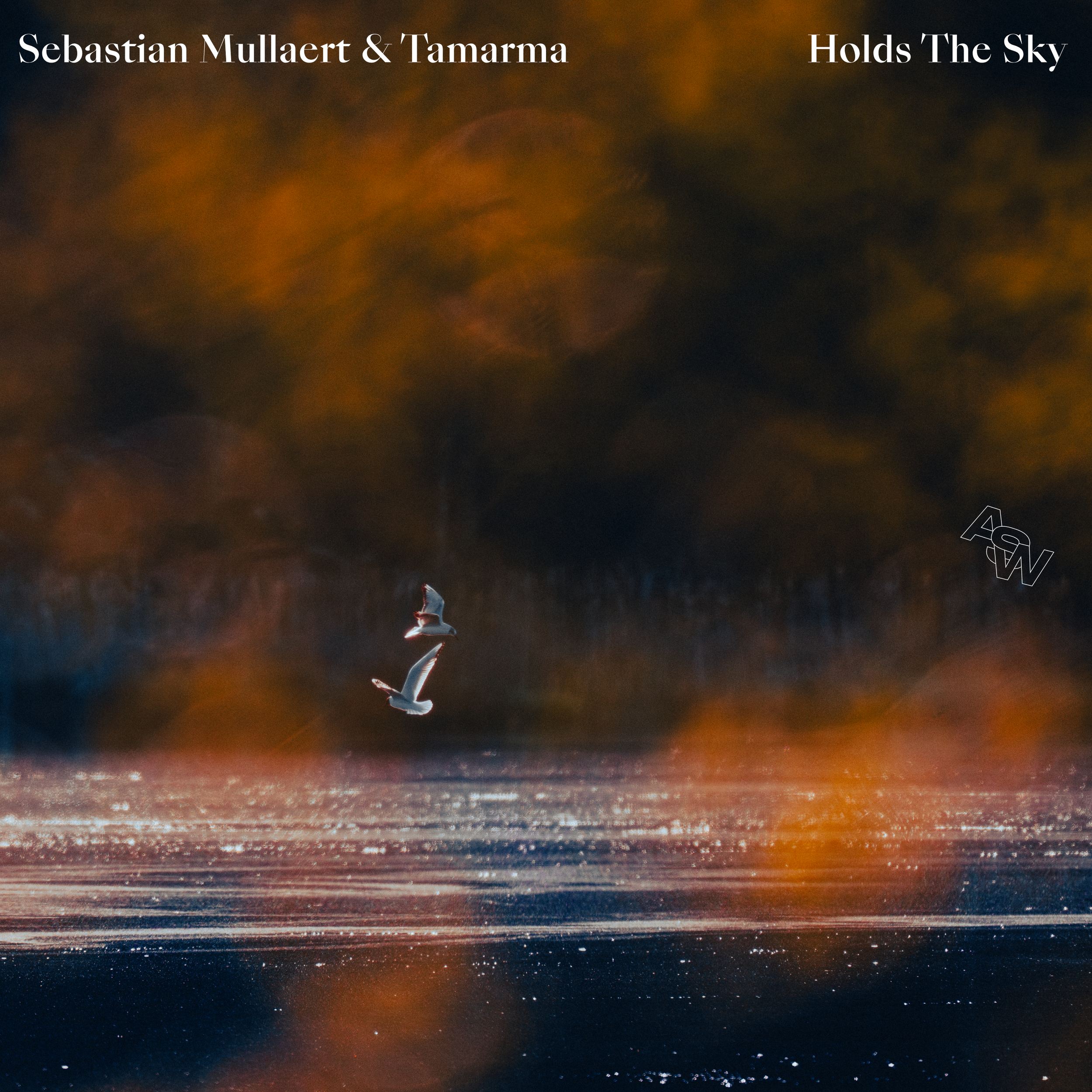
For me, the title also refers to the cover of the album. The cover is a photograph of two birds playing and dancing on a lake here in the woods of Söderåsen. I took that photo on one of my many, many, many walks with my camera in the woods here.
And as a little side note, I think when we meet life, when we meet playfulness, when we meet the creative act in nature and in the world, it is always the most beautiful teacher and inspiration for us to invite and allow that in ourselves.
So you could potentially see these two birds as the two of us, Tamara and me, allowing this music, this creative act. And here, those birds in a way holds the sky.
Allowing our creativity, and that journey of allowing our creativity, is for me a way to really rest into our deepest essence of awareness. It is this interconnected dance of the unformed with the form, the unborn with the born, the still with the moving, presence and the creation of the world, awareness and the allowing of creativity.
In this way, they both hold each other and become one in each moment. And in this way, the dance is holding the sky, the Devine, the awareness in all.
T: It could mean whatever holds the sky for each person. I will keep it open-ended.
The music moves away from the dancefloor at points, leaning towards performance and listening on a deeper level. Is this something you set out to achieve, or was a natural evolution of your sound together?
S: We didn’t have any specific aim or genre perspective for this album. It really took its own way. I think the most important thing for me is that this is our musical expression, and the album itself is simply us sharing what came out of our collaboration.
Along the way, I felt a spark to make a few more dance floor friendly versions, which turned into three different reworks. But those came afterwards. The album itself was never created with a specific setting or purpose in mind. It was just us allowing the music to become what it wanted to become.
T: Every step of this album felt organic. We let ideas heat up, settle and cool down. After giving them that space, the shapes just appear by themselves.
Your ethos is evidently built around live performance and improvisation. How important is it to you that people continue to spread this message as club culture evolves?
S: As I said initially, this beautiful core of the label Awesome Soundwave is really why I want to be part of the Awesome Soundwave family and why I want to co-create with them as a label.
We have different intentions when we do things in life, and everyone needs to explore that and make their own decisions. I think, in one way, we could see everything we do as invitations. We invite ourselves, we invite others into settings, spaces and moments of all dimensions: physical, emotional, intellectual.
And these invitations can be designed in different ways. They can hold different intentions, they can be more or less driven by an agenda. My wish, and what I try to invite into, is always: how can I allow my expression of creativity? How can I welcome others? Can I live with this invitation and maybe, at times, be an inspiration for others to find that spark, curiosity and motivation to explore their own creativity?
And I think the idea of releasing improvised and live-made music also carries that invitation. It invites people to explore, to play and to allow their creativity. That’s why I was attracted to working with Awesome Soundwave in the first place.
T: My foundation is in classical piano performance. Improvisation came much later. Surprisingly the first real catalyst for free thinking was liturgical chants. I think improvising with whatever you have in the moment, gives you a much richer understanding of your own music. Performing live brings that full circle.The feedback loop for your development becomes much shorter. Growing together with an audience in that shared space is something I deeply cherish.
Can you tell us about other projects you are working on at the moment? More collaborations on the horizon?
S: Indeed, there are many more interesting projects and collaborations on the horizon for me, as the exploration of collaboration has become a very important part of what I do and something I feel genuinely curious about. Also finding that balance of how to nurture my introvert aspects as well as my extrovert aspects within a collaboration, how to communicate that, how to listen and how to encourage that in the other person. Creating music together from this collaborative perspective is something I feel a lot of spark for.
I’m continuing my Circle of Live project, and that is really all about this: welcoming different artists, and even different artistic expressions, into a free-form, non-planned improvisation. It can happen in a club context or in a seated concert context.
I’m also starting a new experiment, a new project, which I’m very curious about. It’s something that evolved from my own creative explorations, then later included others by inviting them into that exploration, and now I’m taking it another step. The project is called A Place Called. Basically, I come to a place, together with an invited artist, and have a residency there for around five days, exploring the space, exploring the relationship and exploring sound together.
We work from a listener perspective. So if we are in a club, for example, we would stand in the middle of the club, working with the PA around us. At the end of the residency we open the doors, and that’s the concert. We are surrounded by the audience, and the audience becomes part of the performance. We recorded it, and that became the album.
Everything around the album, the photos, artwork, press release, is also created in the same way. We invite everyone who will express those different parts to be present during the residency or the concert and create while the music is being created. So, kind of from a typical jazz perspective, we choose a space, let that space become the foundation of the exploration, and then let what happens become the result, without fixing and polishing it afterwards.
The first episode is in mid-September in Malmö, and it’s me and Dorisburg. And there is another little experiment within this. As a little question, or maybe an invitation to the world, we will allow everyone who takes part in the concert to become copyright holders of the album and the music. It’s a little invitation, a little challenging question towards what copyright means, acknowledging that everyone within a space, everyone’s energy and everyone’s part in the collective experience, is part of what is created. In this way we will also explore, and maybe challenge a little bit, the normal idea of an artist versus a crowd.
On top of this, I have a lot of other collaborations going on. Some of them also come from people who are genuinely curious about my workflow and my creativity, coming to my retreats or workshops, and then a certain spark or attraction leads into a collaboration. I really love to let my work evolve in that way, because it comes from something very genuine and leads to very genuine expressions.
T: Right now, my whole focus and energy are dedicated to this release. But if new ideas or music emerge naturally during the process, I put them in the chest for later.
A deeper question for you both to round this off, do you think understanding music on an immersive level helps you understand more about yourself and the world?
S: Thank you for that. I always love to get the chance to contemplate these types of questions. And I think that’s also what naturally happens when we explore our creativity.
So maybe I would like to divide my answer into different parts. First, to really immerse yourself in a musical experience is to be part of it. It could be playing with it, moving with it, singing with it. It could be just holding space for it and allowing emotions with it, or allowing thoughts and visions to take place. That is to allow creativity, and to allow creativity is to allow life.
So in this way, again, I think a piece of music, whether it’s performed live or is on a record, is an invitation for anyone to continue that creative act.
This is also something we will actually invite everyone to do. We have a little separate project based on the album where I have created very reduced and sparse soundscapes from the songs on the album. Tamara has then, in a very spontaneous and raw way, expressed herself with these soundscapes through piano, voice or both. And we will share these with everyone who wants to explore, sing, dance, play or produce with them. They will be available both as sound files that you can simply download, play and create with, and as Ableton files for people who want to continue the creative act from more of a production angle.
The second part of my answer is about the word understanding. And I think this is one of the core parts of allowing your creativity, allowing your body to be part of it and acknowledging all the energies that flow through and are part of your ongoing creative act.
You don’t need to understand that. You need to understand that you don’t need to understand it.
It’s allowed. It’s happening. You don’t need to force it. You don’t need to pressure it. It’s a beautiful blossoming happening, and you are giving birth to that, or letting it flower completely, when you hold presence and hold space for it.
I often try to invite people into more raw and improvisational settings, and my wish with that is to inspire something beyond the thoughts, something beyond the understanding, and to welcome people to take part, to take the step, to act. And then it happens by itself.
We could write long answers in an interview like this about it. We can write beautiful books about it, and that can be very enjoyable and fascinating to read. But it’s not what will make it happen.
You just need to take the step and dance.
T: Absolutely, that’s really the main reason I could never stop creating. When you fully give yourself to the process, so many dormant parts of yourself come to life. If you don’t let it scare you, you get to meet those parts of yourself and meet others on a much deeper level too. It’s an experience I’ll never get bored of.